- Is Osteoporosis Hereditary? What a Polygenic Risk Score Can and Cannot Tell You
- What you’ll learn
- Osteoporosis is polygenic — there is no single “osteoporosis gene”
- How much risk is that, in real numbers?
- What a 23andMe “Osteoporosis” report is — and what it is not
- Reading your result without over-reading it
- Prevention that actually moves bone
- Treatment landscape, and what the denosumab biosimilar timeline means
- Family, insurance, and privacy: what to share and what GINA leaves out
- Frequently asked questions
- Will I definitely get osteoporosis if my mother had a hip fracture?
- Should I get a bone density scan earlier than 65 because of my genes?
- Will my children inherit this?
- Will a genetic result affect my health or life insurance?
- Can my employer find out?
- Should I get a second opinion on my result?
- Can osteoporosis be reversed, or only slowed?
- Summary
- References
Is Osteoporosis Hereditary? What a Polygenic Risk Score Can and Cannot Tell You
This article is for educational purposes only. It is not a substitute for advice from a licensed physician, board-certified medical geneticist, or board-certified genetic counselor. For any decisions about testing, treatment, or care, consult a qualified clinician. In emergencies, call 911.
My mom broke her hip a few years ago. She has barely been out of bed since. I keep wondering if that is coming for my wife and me.

That worry brings a lot of people into the genetics clinic, and it is a fair one. Bone strength does run in families, but research describes it as many small genetic pushes rather than one switch.
So should I just order one of those spit kits and find out?
Hold that thought for now. What an at-home report can and cannot answer is a real question, and the published position statements from genetic counselors are quite direct about its limits.
And my wife? Her mother is fine, but I read that this hits women much harder.
It does, and national survey data from the United States show that gap clearly. It is one reason screening advice for women is written differently from the advice for men.
Okay. So what do I actually do with all of this?
The sections below cover what the genetics really show, what the guidelines act on today, and what prevention has trial support. Then take it to your family doctor, who can order the checks that count.
Bottom line: Osteoporosis runs in families, but it is polygenic — many genes each add a little. A 2025 genome-wide study of more than 30,000 UK Biobank volunteers mapped 91 spots in human DNA linked to bone density and fracture. A 2026 study of 223,818 women then turned those scores into calendar time. The 10-year risk that the average woman meets at age 65 arrives at age 60 in the highest-risk group and at age 69 in the lowest. That finding is real research. It is not yet part of the screening advice from the US Preventive Services Task Force (USPSTF) or from Osteoporosis Canada.
What you’ll learn
- Why bone density is a polygenic trait, and what the 2025 UK Biobank study really found
- How a risk score turns into a start age of 60, 65, or 69 — and why that is research, not advice
- What an at-home DNA report can and cannot do, and which test a doctor will act on
- Where prevention, drugs, family history, and US and Canadian privacy law leave you today
Osteoporosis is polygenic — there is no single “osteoporosis gene”
Is there an osteoporosis gene? I keep picturing one broken thing I inherited from my mom.
That picture fits some rare bone disorders, but not the common age-related kind. A 2025 genome-wide study mapped 91 separate spots linked to bone density, each nudging it by a small amount.
The usual picture is wrong: one broken gene, like a light switch. Some bone diseases really do work that way. Osteogenesis imperfecta, the “brittle bone disease,” is caused about 90% of the time by changes in COL1A1 or COL1A2. Those two genes follow an autosomal dominant pattern, meaning one copy from either parent is enough.
Plain old age-related osteoporosis is not built like that. Bone density sits on a sliding scale, like height or blood pressure. Thousands of common gene changes nudge it up or down by tiny amounts. That is what polygenic means: many genes, each with a small say.
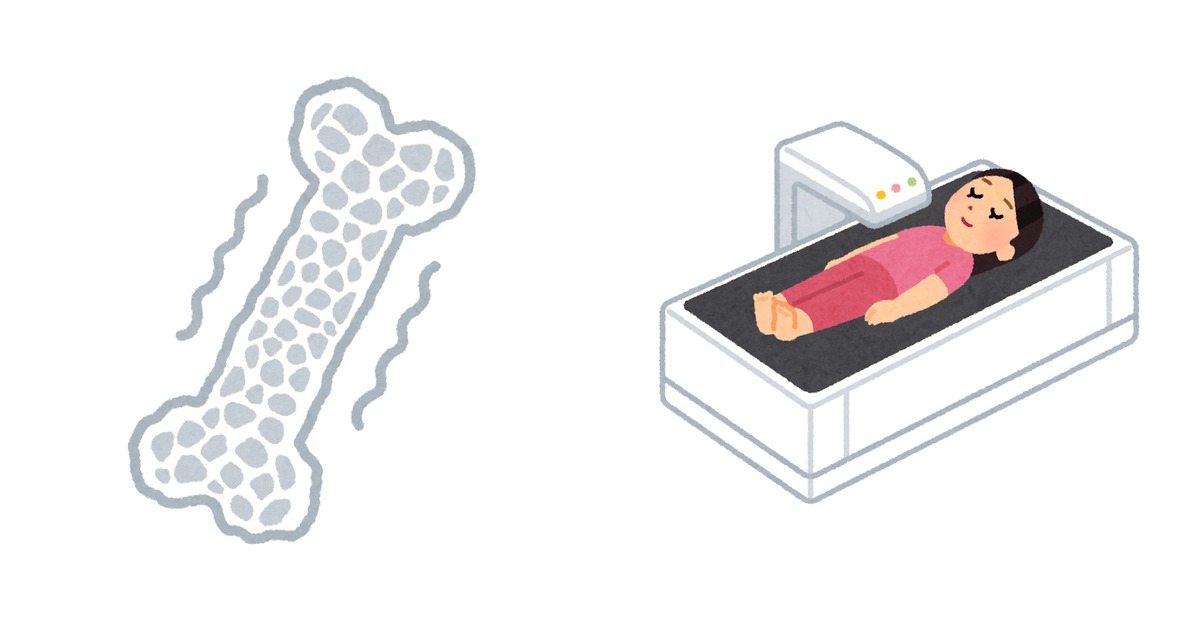
The best map available comes from a 2025 study. Researchers scanned the whole genome for spots tied to bone density. Density was measured by DXA scan (dual-energy X-ray absorptiometry, the standard bone density scan) at 11 places in the skeleton. The group was more than 30,000 people of European descent in the UK Biobank.
They found 91 separate spots, or loci, linked to 11 bone density traits and to fracture. Five of the 91 were new. They sit next to the genes ABCA1, CHSY1, CYP24A1, SWAP70, and PAX1. The same five showed up in both men and women, which the authors treat as independent replication.
The study found the places. What each of those genes does day to day is long-known cell biology, set out here in plain terms so the map makes sense.
| Gene at a new locus | Everyday role in the body | Why bone would care |
|---|---|---|
| CYP24A1 | Breaks down the active form of vitamin D | Sets how long active vitamin D stays on hand for calcium |
| ABCA1 | Moves cholesterol and fats out of cells | Ties fat transport to bone — the least obvious of the five |
| CHSY1 | Builds chondroitin sulfate chains | Those chains are part of the cartilage and bone matrix |
| SWAP70 | Signal protein in the cells that strip bone away | Bone is torn down and rebuilt for life; this sits on the teardown side |
| PAX1 | Gene that switches other genes on during growth | Shapes how the skeleton forms in the first place |
Think of bone as a building under constant repair. One crew strips out old material and another lays down new. In youth the building crew wins, and bone mass peaks by the mid- to late twenties. Later the balance tips the other way. For many women, bone loss starts a year or two before menopause, when estrogen levels begin to fall.
If it is spread across that many genes, is there anything worth testing for at all?
For most families there is no single change to chase. That same study flagged ESR1 and SREBF1 as drug targets instead, so bring your mother’s fracture to your family doctor rather than a gene list.
The same 2025 study also matched gene-activity data to the genetic signals. That step flagged ESR1, the gene for an estrogen receptor, and SREBF1 as top drug targets. The genetics feed the search for drugs, not just risk labels.
Carry one sentence through the rest of this article. Your genes shape how much bone you build and how fast you lose it. They do not hand you a diagnosis. If your family history worries you, take that worry to your family doctor, not to a search bar.
Section recap: Osteoporosis is polygenic, spread over at least 91 mapped spots rather than packed into one gene. Single-gene bone disease is real, but it is a different diagnosis with a different pattern.
How much risk is that, in real numbers?
Give me a number. How likely is this, really?
A national US health survey found that about 20 in every 100 women over 50 have osteoporosis, and far fewer men. A risk figure only means something once you know the group it came from.
A percentage means nothing without a denominator — the group it is counted out of. So start with the group. Among US adults aged 50 and over surveyed in 2017-2018, the age-adjusted rate of osteoporosis was 12.6%. For women it was 19.6% — roughly 20 out of every 100 women over 50. Those numbers come from NHANES, the National Health and Nutrition Examination Survey, a long-running US health survey.
| Measure (US adults 50+, NHANES 2017-2018) | Overall | Women | Men | Ages 50-64 | Ages 65+ |
|---|---|---|---|---|---|
| Osteoporosis | 12.6% | 19.6% | 4.4% | 8.4% | 17.7% |
| Low bone mass | 43.1% | 51.5% | 33.5% | 39.3% | 47.5% |
Source: NCHS Data Brief No. 405.
Now the genes. A 2026 study followed 223,818 UK Biobank women who were free of the disease at the start. The team sorted them into low, medium, and high polygenic risk groups. Then it asked one simple question. At what age does each group reach the same level of risk?
The paper reports that in the general female population at age 65 — the age USPSTF names for screening — the 10-year risk of being diagnosed was 5.95%. In plain terms, about 6 out of every 100 women in that spot are diagnosed over the next ten years. About 94 out of 100 are not.
| Polygenic risk group | Age at which 10-year risk reaches 5.95% |
|---|---|
| High | 60 |
| General female population | 65 |
| Low | 69 |
Source: BMC Medicine 2026 cohort study.
The study also reports the gap as a “risk advancement period” — how far the clock moves. High-risk women were diagnosed 4.99 years earlier than medium-risk women (RAP, 4.99; 95% CI, 4.94, 6.28). Low-risk women were diagnosed 4.89 years later. The paper writes that second figure as a minus number (RAP, −4.89; 95% CI, −6.54, −4.69), where the minus sign means later, not smaller. So the spread is close to even: about five years sooner one way, about five years later the other.
Read that with care. It is a shift of about five years in the queue. It is not a doubling of certainty, and it is not a verdict. A woman in the high-risk group is still far more likely to reach 65 with no diagnosis than with one.
Five years earlier sounds like a lot. Should my wife get scanned at 60, then?
That five-year shift comes from a study that only watched what happened, in a mostly European-descent group. Her family doctor decides scan timing, and current screening advice does not use a risk score.
Two limits matter as much as the numbers.
First, the study only watched what happened. It was not a trial that split women between different screening ages at random. The authors call the result “precision prevention,” not settled practice.
Second, both the 2025 map and the 2026 study were built in the UK Biobank, whose members are mostly of European descent. Risk scores travel poorly across ancestry groups. If you are Black, Hispanic, East Asian, South Asian, or Indigenous, treat these figures as a poorer fit for you. Say so out loud when you talk them over with your doctor.
Section recap: About 20 out of 100 US women over 50 have osteoporosis. A risk score moved the equal-risk screening age from 65 to 60 or 69 in one study of European-descent women that only watched what happened.
What a 23andMe “Osteoporosis” report is — and what it is not
I already have a 23andMe report sitting in my account. Does it mean anything?
It is a likelihood built from thousands of common gene changes, and the company itself states that such reports are not meant to guide medical decisions or replace recommended screenings.
If you are holding an at-home report, know what you bought. The 23andMe Osteoporosis report sits under “polygenic reports,” is built on more than 22,000 gene changes, and carries the “Powered by 23andMe Research” label. 23andMe states that reports in that group have not been reviewed by the FDA, unlike the company’s FDA-authorized three-variant BRCA1/BRCA2 report.
The company’s own wording is blunt. These reports “are not intended to tell a person anything about his or her current state of health, or to be used to make medical decisions”. The test, it adds, “is not a substitute for visits to a healthcare professional for recommended screenings”. Results “should be confirmed in a clinical setting before taking any medical action”.
The National Society of Genetic Counselors (NSGC) makes the same point from outside. Tests that people order for themselves “vary in analytical and clinical validity, scope of results, variant interpretation and reporting, regulatory oversight, and the degree of healthcare professional involvement”.
A genetic counselor is a health professional trained in both genetics and counseling, at master’s level, and is not a doctor. The visit is mostly a talk: they map your family tree, explain what a test can and cannot show, and help you weigh whether to test at all.
It helps to see the three tiers side by side.
| Tier | What it is | What it can answer | Who orders it |
|---|---|---|---|
| At-home array report | A likelihood, relative to other people, built from many common gene changes | Roughly where you sit in a spread | You, online |
| Clinical gene panel | Doctor-ordered sequencing for single-gene bone disease, such as COL1A1/COL1A2 or ALPL | Whether one inherited bone disorder is present | A doctor or genetic counselor |
| DXA plus FRAX | A bone density scan plus a 10-year fracture score | Your real bone density and fracture risk | A doctor |
The third row is the one that changes care. USPSTF describes screening as “a central DXA BMD, with or without fracture risk assessment,” where BMD is bone mineral density. A DXA scan is quick, painless, and does not break the skin. If you can only get one thing done this year, make it a DXA scan and a FRAX score — not a spit kit.
So what should I book instead, for me or for my wife?
Ask your doctor about a DXA bone density scan and a FRAX fracture score, which is what screening guidance actually names. Coverage rules differ by plan and by province, so check yours before booking.
Cost is a fair question, and the answer differs by country and by plan.
- US, Medicare: Part B covers a bone mass test once every 24 months for people who meet at least one qualifying condition. It can be covered more often when it is medically necessary. Medicare states, “You pay nothing for this test if the doctor or other health care provider accepts assignment”.
- US, marketplace plans: HealthCare.gov lists this under preventive care for women. The wording covers “all women over 65 years or women 64 years and younger who have gone through menopause,” usually at no cost with an in-network provider. It sits on the women’s list, not the general adult list.
- Canada: bone density testing runs through each province and territory, and the rules differ. Check your own province.
Whatever your plan says on paper, check your own coverage before you book, and ask the doctor’s office to confirm the billing code.
Section recap: An at-home risk report is a likelihood, and its own maker says it should not drive medical choices. The tools that change care are DXA and FRAX.
Reading your result without over-reading it
My report says increased likelihood. Is that the same as carrying a bad variant?
No. Harmful or uncertain variant labels come from single-gene testing, such as panels for brittle bone disease. A likelihood bucket carries no such label, and no current screening guideline acts on one.
At-home risk reports and clinical gene panels speak different languages, and the two are easy to confuse.
A risk report gives you a rank or a bucket — “typical likelihood,” “increased likelihood.” It does not label a gene change as harmful, harmless, or unclear. Those labels belong to single-gene testing, where a lab judges one exact change in one gene. A variant of uncertain significance means the lab found a change but cannot yet say whether it causes disease. You may see that phrase on a clinical bone panel for osteogenesis imperfecta or hypophosphatasia. You will not see it on a polygenic osteoporosis report.
Now set your hopes for the visit. A direct check of the current USPSTF osteoporosis screening statement found no mention of polygenic risk scores or genetic testing anywhere in it. Neither the 2022 Clinician’s Guide from the Bone Health and Osteoporosis Foundation (BHOF) nor the 2023 Osteoporosis Canada guideline uses a risk score in its risk-check path. Both route risk through FRAX, with CAROC, a Canadian fracture-risk tool, named as the alternative. So a US or Canadian doctor has no guideline that would let an at-home score change the plan.
USPSTF grades its advice with letters. A grade B means it advises the step. A grade D means it advises against the step. An “I statement” means the evidence is not enough to say either way.
What the guidelines do act on:
- United States: a grade B for screening women 65 or older. A second grade B covers women past menopause and under 65 whose risk check puts them at higher risk. For men, the evidence was judged not enough.
- Canada: a bone density test for people aged 50-64 with a past fracture linked to weak bone, or with 2 or more clinical risk factors. Also for people 65 or older with 1 risk factor, and for everyone aged 70 or older. Canada’s default starts later than the US age-65 anchor.
The useful move is to turn your worry into inputs the doctor already uses. FRAX blends clinical risk factors with bone density at the femoral neck, the narrow part at the top of the thigh bone. It returns a 10-year chance of hip fracture and of major fracture. Its checked input fields include age, sex, weight, and height. They also include past fracture, parent fractured hip, current smoking, glucocorticoid use (long-term steroid pills), rheumatoid arthritis, secondary osteoporosis, and alcohol at 3 or more units a day.
Notice one item in particular. “Parent fractured hip” is a named FRAX input all on its own. Your mother’s hip fracture already counts, with no DNA test needed. USPSTF likewise names a parent’s hip fracture among the clinical risk factors it uses. The National Institute of Arthritis and Musculoskeletal and Skin Diseases (NIAMS) states that your risk may rise if a parent has a history of osteoporosis or hip fracture.
So my mom’s hip fracture counts for more than my DNA report does?
In the tools clinicians already use, yes. Parent fractured hip is a scored FRAX input on its own, so write down her fracture and ask your doctor to run a FRAX score for you.
Bring this to the visit instead of a rank:
- Any fracture you had after age 50 from a minor knock or fall
- A parent’s hip fracture, or a spine fracture on record, with rough ages
- Height loss, and how much
- Long-term steroid pills, past or current
- Whether you smoke, and how much you drink in a week
- Age at menopause, and whether it came early
Ask straight out for a FRAX score. That turns the talk from “my DNA test said” into numbers your doctor can enter and act on.
One more point about reading results. Bone density comes back as a T-score, which compares your bone with that of a healthy young adult. Doctors use set cut-offs to mark low bone mass and osteoporosis. Ask your doctor where your number falls. Note that once the disease is diagnosed, the diagnosis stays even if a later DXA T-score rises above the cut-off.
Section recap: A rank is not a variant label, and neither USPSTF, BHOF, nor Osteoporosis Canada acts on a polygenic score. Family fracture history, by contrast, is already a scored FRAX input.
Prevention that actually moves bone
Can I still change anything at my age, or is it already set?
Quite a lot is still open. A Cochrane review of exercise trials found that progressive strength training raised bone density at the hip and spine, and the LIFTMOR trial saw larger gains with coached high-force training.
This is also an area where marketing can outrun the evidence. Sort the steps by how strong the trial support really is.
| Step | What the evidence shows | How strong |
|---|---|---|
| Strength and impact training | Raises bone density at spine and hip | Best trial support for density |
| Exercise to prevent falls | USPSTF grade B for adults 65+ living at home at higher fall risk | Best graded support that touches fractures |
| Calcium and vitamin D | Enough intake matters; low-dose supplements drew a 2018 grade D for healthy women past menopause | Depends on your own status |
| Not smoking, less alcohol, fewer steroid pills | Each is a scored FRAX risk factor | Worth a talk with your doctor |
Peak bone mass comes first, and it is mostly settled early. Bone tissue peaks by the mid- to late twenties. That makes this part more urgent for a reader’s grown daughter than for the reader herself. Loading the skeleton often, and not smoking, build the most margin for later.
Strength training has the best trial support for bone density. A Cochrane review pooled 43 trials with 4,320 people. For the femoral neck, the best category was high-force work that does not carry body weight — step-by-step strength training for the legs. The mean difference was 1.03 in percent change from baseline (95% CI 0.24 to 1.82). For the spine, mixed programs did best, with a mean difference of 3.22 (95% CI 1.80 to 4.64).
One tougher trial pushed those numbers higher. LIFTMOR split 101 women past menopause with low bone mass, mean age 65, into two groups at random. One group did eight months of twice-weekly, 30-minute coached high-force strength and impact training. Spine density rose 2.9% in that group and fell 1.2% in the control group (p < 0.001). Femoral neck density rose 0.3% against a 1.9% fall (p = 0.004). Only one injury occurred — and the whole program was closely coached, which is part of that safety record, not a footnote.
Be honest about the ceiling. The same Cochrane review found no clear effect on the number of fractures. Its result was an odds ratio of 0.61, with a confidence interval from 0.23 to 1.64.
Two terms there are worth unpacking. An odds ratio weighs the odds of a fracture in the exercise group against the odds in the control group. A value of 1.00 means no difference, and a value below 1.00 hints at fewer fractures. The confidence interval is the range the true value most likely falls in. Because this range runs from below 1 to above 1, the data fit “fewer fractures,” “no change,” and “more fractures” alike — so nothing is proven either way.
That review dates from 2011, and LIFTMOR enrolled 101 people with density, not fracture, as the outcome. Exercise has proof for bone density. From these two sources, it does not yet have proof for fractures.
The graded proof that touches fractures sits with falls. In 2024, USPSTF gave a grade B to exercise programs that prevent falls. It applies to adults 65 or older who live at home and are at higher risk of falling. Offering many-part fall programs to everyone drew only a grade C.
The scale is large. In 2018, 27.5% of adults 65 or older living at home reported at least one fall. An estimated 38,742 deaths followed fall-related injuries in 2021. A fracture needs two things — weak bone and a fall. Halving your chance of falling protects bone by another route.
Canadian guidance is exact about the dose. It strongly advises balance and function training at least twice a week to cut fall risk. It adds step-by-step strength training at least twice a week, including work for the belly and back muscles.
Should my wife and I just start taking calcium and vitamin D to be safe?
Fix a shortfall rather than reaching for pills by reflex. A 2018 US task force statement advised against low-dose calcium plus vitamin D for healthy women past menopause, so ask your doctor what applies to each of you.
Nutrition: fix a shortfall, do not reach for pills by reflex. NIAMS lists 1,200 mg of calcium and 600 IU of vitamin D a day for women aged 51-70, rising to 800 IU after 70. Canadian guidance cites Health Canada intake values of 1,200 mg of calcium a day for women over 50. It adds a 400 IU vitamin D pill on top of foods rich in vitamin D. Vitamin D also loops back to the genes: CYP24A1 is one of the five new spots on the map, and it breaks down the active form of vitamin D.
Now the contested part, stated with care. In 2018, USPSTF issued a grade D — advice against — for one exact pairing of pills. The target was a daily dose of 400 IU or less of vitamin D plus 1,000 mg or less of calcium. The group was women past menopause living at home, and the goal was to head off a first fracture. It issued I statements, meaning not enough evidence, for higher doses, for men, and for women before menopause. It also found adequate evidence that vitamin D plus calcium pills raise the number of kidney stones.
The scope limit is critical. Those statements “do not apply to persons with a history of osteoporotic fractures, increased risk for falls, or a diagnosis of osteoporosis or vitamin D deficiency”. If you already have thin bone, a past fracture from a minor knock, a high fall risk, or a proven shortfall, that 2018 statement is not about you. The USPSTF page for the topic also now shows that it is being updated. Ask your doctor what applies to your own case rather than sorting yourself into a box.
Finally, FRAX scores several risks that you can still act on. They are past fracture, current smoking, glucocorticoid use, rheumatoid arthritis, secondary osteoporosis, and alcohol at 3 or more units a day. Low body weight is also named among the USPSTF clinical risk factors. Every one of those is worth a talk with your family doctor this year.
Section recap: Strength and impact training has the best bone density evidence. Exercise to prevent falls carries a USPSTF grade B. Low-dose calcium plus vitamin D drew a 2018 grade D that leaves out people who already have thin bone or a proven shortfall.
Treatment landscape, and what the denosumab biosimilar timeline means
My mom’s bones are already thin. Is there anything left to do for her?
Yes, and that is the hopeful part here. Health agency material lists bisphosphonates, denosumab, and bone-building drugs, some slowing the teardown of bone and others pushing new bone on.
Osteoporosis differs from many inherited conditions in one hopeful way: drugs that work already exist. NIAMS lists the main classes as bisphosphonates, denosumab (a RANKL inhibitor), teriparatide (a PTH analog), abaloparatide (a PTHrP analog), and romosozumab (a sclerostin inhibitor). In plain terms, the first two slow the crew that strips bone away, while the last three push the crew that builds it back.
Two facts shape how these are used. First, spine fractures compound. A spine fracture, painful or found by chance, carries a 5-fold higher risk of further spine fractures. It also carries a 2- to 3-fold higher risk of fractures elsewhere. Second, the benefit is rented, not owned. The BHOF Clinician’s Guide puts it plainly: “Skeletal deterioration resumes sooner or later when a medication is discontinued — sooner for nonbisphosphonates and later for bisphosphonates”.
Denosumab is the sharpest case of that rule, and it is a real safety issue, not a technicality. The FDA-approved PROLIA label states in its Warnings and Precautions: “Multiple vertebral fractures have been reported following Prolia discontinuation. Patients should be transitioned to another antiresorptive agent if Prolia is discontinued”. That wording sits in FDA-approved labeling — drafted by the maker and approved by the agency — rather than in a society opinion. Canadian guidance is just as firm on timing. The shot, given every 6 months, “should not be delayed by more than 1 mo because of the risk of rapid bone loss and vertebral fractures”.
The same label carries a boxed warning — the FDA’s strongest label warning — for very low blood calcium. It applies to patients with advanced kidney disease, including those on dialysis, and hospital stays and deaths have been reported. Other labeled warnings include jaw bone death (osteonecrosis of the jaw), unusual thigh-bone fractures, serious infections, and allergic reactions. The label also tells patients to get enough calcium and vitamin D, and to correct low calcium before starting. None of this makes denosumab a bad drug. It makes it a drug that needs a plan, prescribed and watched by a doctor.
Then the cost story. The FDA’s own Drugs@FDA database records the approval dates below. Each row carries a Biologics License Application (BLA) number, the file number the FDA gives a biologic drug.
| Application | Product | Sponsor | Original approval |
|---|---|---|---|
| BLA 125320 | PROLIA / XGEVA (original denosumab) | Amgen | 2010-06-01 |
| BLA 761362 | JUBBONTI / WYOST (denosumab-bbdz) | Sandoz | 2024-03-05 |
| 9 other applications | Denosumab biosimilars | Various | 2025 or later |
A query of that database on 2026-09-03 returned 11 denosumab applications. Every non-originator application other than BLA 761362 had an original approval date in 2025 or later. That order makes BLA 761362 the earliest denosumab biosimilar approval on record in the FDA’s database, read straight from the regulator’s data.
Why should a patient care about a file number? Because a biosimilar — a near-copy of a biologic drug that other firms may sell once the original’s patents run out — is what turns a costly drug into an affordable one. It is a cost and access story, not a new way of working.
She hates injections. Could she just stop the shot if she wanted to?
That is the one thing not to do alone. The FDA-approved denosumab label warns of multiple spine fractures after stopping and says patients should be moved to another drug, so any change belongs with the doctor who prescribes it.
For Canadian readers, the timeline runs on its own track. Health Canada’s Drug Product Database lists JUBBONTI as “Marketed,” with an original market date of 2024-07-25. WYOST is listed as “Marketed” from 2024-06-26. Each has a Drug Identification Number (DIN), the code Health Canada gives a drug on the market: JUBBONTI is DIN 02545411 and WYOST is DIN 02545764.
Both are Sandoz Canada products, so denosumab biosimilars really are on the market in Canada. That database shows market status rather than approval dates, so no Health Canada approval date is stated here. Public drug coverage in Canada runs through each province and territory and differs, so check your own province’s drug list.
The genes loop back here too. The 2025 study flagged ESR1 and SREBF1 as drug targets, and raised omega-3 fatty acid supplements as a possible reuse candidate for prevention. Today’s drug targets and tomorrow’s candidates come from the same map. A hunch in a genetics paper is not a treatment plan, and any change to your drugs belongs with the doctor who prescribes them.
Section recap: Bisphosphonates, denosumab, and bone-building drugs treat osteoporosis by measurable amounts. Denosumab must never be stopped without a hand-over plan. US biosimilar entry since 2024-03-05 is a cost story, not a new way of working.
Family, insurance, and privacy: what to share and what GINA leaves out
Should I send kits to my sister and to my wife?
There is no single change for relatives to be tested for here, so kits add little. A three-generation record of fractures, height loss, and early menopause is the part clinicians can actually use.
Two practical threads close the loop: what to tell relatives, and what a test result can be used for.
There is nothing to cascade-test. For a single-gene disease, relatives can be tested for the one change found in the family. That is cascade testing. A polygenic trait has no single change to chase, so mailing kits to your siblings achieves very little. What is truly useful is the family history itself. Parent fractured hip is a named FRAX input, and NIAMS confirms that a parent’s history of osteoporosis or hip fracture may raise your own risk.
So build a three-generation record and share that instead:
- Every fracture from a minor knock in parents, siblings, aunts, uncles, and grandparents, with rough ages
- Any hip or spine fracture on record, which carries the most weight
- Clear height loss or a stooped upper back in older relatives
- Age at menopause for female relatives, above all if it came early
- Long-term steroid pills, heavy smoking, or heavy drinking in the family
- Any relative with unexplained fractures starting in childhood, or early tooth loss, which can point toward single-gene bone disease
That last line matters. Adult hypophosphatasia, caused by changes in ALPL, can show up as repeat fractures of the foot and thigh bones plus early tooth loss. Osteogenesis imperfecta affects roughly 1 in 10,000 to 20,000 people worldwide, with an estimated 25,000 to 50,000 people affected in the United States. That kind of family picture is what rightly triggers a doctor-ordered single-gene panel — not a rank from an at-home report.
For a grown daughter, the leverage is not a test at all. It is peak bone mass and steady loading through her twenties and thirties.
Now the insurance question, where US readers face a real gap. The Genetic Information Nondiscrimination Act of 2008, known as GINA, is Public Law 110-233 and was signed into law on May 21, 2008. The “Nondiscrimination” in its title means a ban on treating people worse because of their genes. Title I covers health insurance and Title II covers jobs. Its health insurance coverage reaches private insurers, Medicare, Medicaid, the Federal Employees Health Benefits program, and the Veterans Health Administration.
One limit of GINA is easy to miss. The National Human Genome Research Institute states that “GINA’s health insurance protections do not cover long-term care insurance, life insurance, or disability insurance”. Long-term care insurance is exactly the product a reader worried about a hip fracture is most likely to shop for. GINA also does not apply to employers with fewer than 15 employees, and the US Military is left out. Some states add protections beyond GINA.
Could testing hurt us later, with insurance?
In the United States, GINA covers health insurance and jobs but leaves out life, disability, and long-term care insurance. A certified genetic counselor can walk you through that gap before anyone tests.
Canada’s law is built on a different frame. The Genetic Non-Discrimination Act, S.C. 2017, c. 3, received assent on May 4, 2017. It works through bans rather than through lists of insurance products.
The Act bars anyone from:
- making a person take a DNA test, or hand over test results, as a condition of providing goods or services
- making that same demand a condition of signing or keeping a contract, or of the terms offered in one
- gathering, using, or sharing DNA test results in those dealings without written consent
Two groups are carved out. Health care providers giving care are excepted, and so are researchers whose participants have agreed.
The penalties are steep. On indictment they reach a fine of up to $1,000,000 and five years in prison. In Reference re Genetic Non-Discrimination Act, 2020 SCC 17, released July 10, 2020, a majority of the Supreme Court of Canada upheld Parliament’s power to pass those bans.
| United States (GINA) | Canada (Genetic Non-Discrimination Act) | |
|---|---|---|
| Legal frame | Health insurance and jobs | Goods, services, and contracts in general |
| Written exclusions | Life, disability, and long-term care insurance | No insurance carve-out in the text of the law |
| Employer size limit | Does not apply below 15 employees | Not framed by employer size |
| Status | Passed 2008 | Passed 2017; upheld by the Supreme Court in 2020 |
One more privacy note: at-home testing firms can change their data-sharing terms and their owners, and your sample and data outlive your first choice. Read the current terms before you test, not after.
For anything to do with telling family, a suspected inherited bone disorder, or whether to test at all, talk to a certified genetic counselor. You can find one through NSGC’s Find a Genetic Counselor directory. NSGC advises counseling before or after an at-home test for people unsure whether it meets their needs.
Section recap: Share fracture history rather than ranks, because a polygenic trait gives relatives nothing to cascade-test. GINA leaves life, disability, and long-term care insurance uncovered, while Canada’s law attaches to contracts in general.
Frequently asked questions
Will I definitely get osteoporosis if my mother had a hip fracture?
No. A parent’s hip fracture is a real risk factor, real enough that FRAX scores it as an input of its own. It is not a verdict. Among US women over 50, about 20 in 100 have the disease. Bring the family history to your family doctor and ask for a fracture-risk score.
Should I get a bone density scan earlier than 65 because of my genes?
Research points to roughly five years earlier for the highest-risk group — one 2026 study put the equal-risk age at 60 versus 65 versus 69. But USPSTF still anchors screening at 65, or earlier for women past menopause whose risk check puts them higher. Ask for a FRAX-based check rather than quoting an at-home score. Canada’s thresholds differ again and generally start later.
Will my children inherit this?
They inherit a mix of common gene changes that shape bone density, not a single disease gene. There is no cascade test to offer them. What helps a younger relative is peak bone mass, which is largely set by the mid- to late twenties.
Will a genetic result affect my health or life insurance?
In the US, GINA covers health insurance and jobs but plainly does not cover life, disability, or long-term care insurance. In Canada, the Genetic Non-Discrimination Act bars making a test or a disclosure a condition of contracts and services in general. Understand that gap before you test.
Can my employer find out?
GINA’s Title II limits the use of genetic information in hiring and at work. It does not apply to employers with fewer than 15 employees, and the US Military is left out. Canada’s law bars making DNA test results a contract condition, or using them, without written consent.
Should I get a second opinion on my result?
If a choice about testing, treatment, or telling family hangs on it, yes. NSGC advises counseling before or after an at-home test for anyone unsure whether it fits their needs. A certified genetic counselor and your family doctor are the right pair to ask.
Can osteoporosis be reversed, or only slowed?
Drugs raise bone density by measurable amounts, and several classes are on offer. But the diagnosis stays even if later T-scores rise above the cut-off. Bone loss also picks up again when the drug stops. Treatment choices belong with your doctor.
Summary
Osteoporosis is inherited in the way height is inherited — a lot, and through many small pushes rather than one switch. The 2025 UK Biobank study gives the clearest map so far, with 91 separate spots. Five of them are new, and their biology spans vitamin D handling, fat transport, matrix building, and bone teardown. The 2026 study of 223,818 women turned those scores into something a reader can picture: a screening date that moves to 60 or 69 instead of 65.
Both halves of that story have to be held at once. The genetics are real and better measured each year. They also come from a study that only watched what happened, in a group of mostly European descent. And no risk-check path in current USPSTF, BHOF, or Osteoporosis Canada guidance uses such a score. The best-performing mix in the 2025 study was several scores plus FRAX clinical risk factors. It came with the authors’ own qualifier: “the improvement was modest in fracture prediction”.
So the useful path does not run through a spit kit. It runs through a DXA scan and a FRAX score that already counts your mother’s hip fracture. Add twice-weekly strength and balance training, plus an honest look at your vitamin D. Read the GINA insurance gap clearly before deciding whether to test at all. Make the appointment. That is the step that changes the number.
This article is for educational purposes only. It is not a substitute for advice from a licensed physician, board-certified medical geneticist, or board-certified genetic counselor. For any decisions about testing, treatment, or care, consult a qualified clinician. In emergencies, call 911.
References
- Qian Y, Xia J, Wang P, et al. Genome-wide Association Studies of over 30,000 Samples with Bone Mineral Density at Multiple Skeletal Sites and Its Clinical Relevance. Genomics Proteomics Bioinformatics. 2025 Oct 28;23(5). PMID 41206123. DOI 10.1093/gpbjnl/qzaf097. https://pubmed.ncbi.nlm.nih.gov/41206123/
- Wang D, Sun W, Liu D, et al. Polygenic risk score-guided personalized osteoporosis screening: a population-based study. BMC Medicine. 2026 Jan 14;24(1):56. PMID 41530839. DOI 10.1186/s12916-025-04601-1. https://pubmed.ncbi.nlm.nih.gov/41530839/
- US Preventive Services Task Force; Nicholson WK, Silverstein M, Wong JB, et al. Screening for Osteoporosis to Prevent Fractures: US Preventive Services Task Force Recommendation Statement. JAMA. 2025 Feb 11;333(6):498-508. PMID 39808425. DOI 10.1001/jama.2024.27154. https://www.uspreventiveservicestaskforce.org/uspstf/recommendation/osteoporosis-screening
- Sarafrazi N, Wambogo EA, Shepherd JA. Osteoporosis or Low Bone Mass in Older Adults: United States, 2017-2018. NCHS Data Brief No. 405. 2021 Mar;(405):1-8. PMID 34029181. https://www.cdc.gov/nchs/products/databriefs/db405.htm
- US Food and Drug Administration. Drugs@FDA denosumab applications (openFDA drugsfda API), including BLA 125320 (PROLIA / XGEVA, approved 2010-06-01) and BLA 761362 (JUBBONTI / WYOST, denosumab-bbdz, approved 2024-03-05). Queried 2026-09-03. https://api.fda.gov/drug/drugsfda.json?search=openfda.generic_name:%22denosumab%22&limit=100
- US Food and Drug Administration. PROLIA (denosumab) prescribing information, via the openFDA drug label API; SPL effective 2026-06-26. https://api.fda.gov/drug/label.json?search=openfda.brand_name:%22PROLIA%22&limit=1
- Health Canada. Drug Product Database: JUBBONTI (DIN 02545411) and WYOST (DIN 02545764), Sandoz Canada Incorporated. Queried 2026-09-03. https://health-products.canada.ca/api/drug/drugproduct/?brandname=jubbonti
- Morin SN, Feldman S, Funnell L, et al. Clinical practice guideline for management of osteoporosis and fracture prevention in Canada: 2023 update. CMAJ. 2023 Oct 10;195(39):E1333-E1348. PMID 37816527. DOI 10.1503/cmaj.221647. https://pubmed.ncbi.nlm.nih.gov/37816527/
- LeBoff MS, Greenspan SL, Insogna KL, et al. The clinician’s guide to prevention and treatment of osteoporosis. Osteoporosis International. 2022 Oct;33(10):2049-2102. PMID 35478046. DOI 10.1007/s00198-021-05900-y. https://pubmed.ncbi.nlm.nih.gov/35478046/
- US Preventive Services Task Force. Vitamin D, Calcium, or Combined Supplementation for the Primary Prevention of Fractures in Community-Dwelling Adults: US Preventive Services Task Force Recommendation Statement. JAMA. 2018 Apr 17;319(15):1592-1599. PMID 29677309. DOI 10.1001/jama.2018.3185. https://pubmed.ncbi.nlm.nih.gov/29677309/
- US Preventive Services Task Force. Interventions to Prevent Falls in Community-Dwelling Older Adults: US Preventive Services Task Force Recommendation Statement. JAMA. 2024 Jul 2;332(1):51-57. PMID 38833246. DOI 10.1001/jama.2024.8481. https://pubmed.ncbi.nlm.nih.gov/38833246/
- NIH National Institute of Arthritis and Musculoskeletal and Skin Diseases. Osteoporosis: overview, diagnosis, treatment and steps to take; Learning About Bones. https://www.niams.nih.gov/health-topics/osteoporosis
- NIH National Library of Medicine, MedlinePlus Genetics. Osteogenesis imperfecta; Hypophosphatasia. https://medlineplus.gov/genetics/condition/osteogenesis-imperfecta/
- Watson SL, Weeks BK, Weis LJ, et al. High-Intensity Resistance and Impact Training Improves Bone Mineral Density and Physical Function in Postmenopausal Women With Osteopenia and Osteoporosis: The LIFTMOR Randomized Controlled Trial. Journal of Bone and Mineral Research. 2018 Feb;33(2):211-220. PMID 28975661. DOI 10.1002/jbmr.3284. https://pubmed.ncbi.nlm.nih.gov/28975661/
- Howe TE, Shea B, Dawson LJ, et al. Exercise for preventing and treating osteoporosis in postmenopausal women. Cochrane Database of Systematic Reviews. 2011 Jul 6;(7):CD000333. PMID 21735380. DOI 10.1002/14651858.CD000333.pub2. https://pubmed.ncbi.nlm.nih.gov/21735380/
- Genetic Information Nondiscrimination Act of 2008, Public Law 110-233 (US Government Publishing Office); and NIH National Human Genome Research Institute, Genetic Discrimination policy page. https://www.govinfo.gov/content/pkg/PLAW-110publ233/html/PLAW-110publ233.htm and https://www.genome.gov/about-genomics/policy-issues/Genetic-Discrimination
- Genetic Non-Discrimination Act, S.C. 2017, c. 3 (Justice Laws Website, Government of Canada); Reference re Genetic Non-Discrimination Act, 2020 SCC 17. https://laws-lois.justice.gc.ca/eng/acts/G-2.5/page-1.html and https://www.scc-csc.ca/judgments-jugements/cb/2020/38478/
- US Centers for Medicare & Medicaid Services, Medicare.gov: Bone mass measurements; and HealthCare.gov: Preventive care benefits for women. https://www.medicare.gov/coverage/bone-mass-measurements and https://www.healthcare.gov/preventive-care-women/
- FRAX Fracture Risk Assessment Tool, maintained by Osteoporosis Research Ltd in association with the University of Sheffield. https://www.fraxplus.org/
- National Society of Genetic Counselors. Consumer-Initiated Genetic Testing Position Statement (approved June 2019, revised November 2025); Find a Genetic Counselor directory. https://www.nsgc.org/POLICY/Position-Statements/Position-Statements/Post/at-home-genetic-testing-position-statement and https://findageneticcounselor.nsgc.org/
- 23andMe. Health Predisposition reports listing, Osteoporosis polygenic score (company product page). https://www.23andme.org/clinicians/genetic-reports/health-predispositions/
Last updated: 2026-09-04
Author: Yu Mizuno (Editor-in-Chief, non-physician), GeneLumen editorial team. This article aggregates 21 sources from peer-reviewed medical literature and public health agencies (tier 1 = 11 / tier 2 = 9 / other = 1), including NIH NIAMS, MedlinePlus Genetics, CDC NCHS, the US Food and Drug Administration, Health Canada’s Drug Product Database, the US Preventive Services Task Force, Osteoporosis Canada, and PubMed-indexed publications.
Editorial responsibility: Yu Mizuno, research editor. Not a physician, medical geneticist, or genetic counselor.
This article is for educational purposes only and is not a substitute for medical advice from a licensed physician, board-certified medical geneticist, or board-certified genetic counselor. In emergencies, call 911.
Related: Genetic Diseases
🇯🇵 For readers in Japan — a separate Japanese edition written for Japan’s healthcare system (not a translation): https://genelumen.com/ja/ja-genetic-diseases/osteoporosis-genetic-risk-polygenic-screening-jp