- LAMB3 Carrier Result Explained: Severe Junctional Epidermolysis Bullosa and Your Real Risk Numbers
- Laminin-332 and the beta-3 chain: what LAMB3 builds
- What one carrier flag means for your own body, including the dental exception
- The arithmetic: your partner’s status is the whole question
- Consumer chip versus full-gene sequencing: the 48 percent number
- What generalized severe JEB looks like, and the subtypes it gets confused with
- Treatment in 2026: dated approvals, and two drugs that are not for this disease
- Telling your family and planning a pregnancy
- Insurance, employment law and the emotional load
- Frequently asked questions
- Summary
- References
LAMB3 Carrier Result Explained: Severe Junctional Epidermolysis Bullosa and Your Real Risk Numbers
This article is for educational purposes only. It is not a substitute for advice from a licensed physician, board-certified medical geneticist, or board-certified genetic counselor. For any decisions about testing, treatment, or care, consult a qualified clinician. In emergencies, call 911.

My carrier report flagged a LAMB3 variant, and my wife and I are trying for a baby. The search results were terrifying.

That reaction is extremely common in the genetics clinic, and it says nothing about your own health. GeneReviews describes this as a recessive condition, so a carrier report is a statement about a possible pregnancy rather than about the person holding the paper.
Honestly, part of me does not want to know more. What if looking into it only makes the worry worse?
That hesitation is normal and it is taken seriously. The published literature on genetic testing generally reports a neutral to mild psychological impact when results are delivered alongside genetic counseling, which is why a counselor belongs in the process rather than at the end of it.
We already have young kids. Does this mean they could develop it too?
Families ask that first, almost every time. Cascade testing, where relatives are checked for the one variant already identified in the family, is well established in professional genetics guidance, and GeneReviews sets out how relatives are counselled once that variant is known.
So what do I actually do with this piece of paper?
This article walks that through in order: what a carrier result does and does not mean, where the real per-pregnancy numbers come from, and how to reach a primary care doctor or a certified genetic counselor through the NSGC directory.
Bottom line: A single LAMB3 variant is a fact about a future pregnancy, not about the carrier’s own body. Junctional epidermolysis bullosa, or junctional EB, is autosomal recessive: a child needs two altered copies of the gene to be affected. GeneReviews reports that carriers have no symptoms, apart from rare dental enamel findings. The 25 percent figure printed on most pages applies only when both parents carry a variant in the same gene. When the partner is untested, the sourced math lands far lower, at about one pregnancy in one to three thousand. The best next step is full-gene sequencing of the partner’s LAMB3, because a consumer chip is expected to find only 48 percent of carriers. On treatment, one correction matters more than any hopeful headline. VYJUVEK and ZEVASKYN treat dystrophic EB, a different skin disease caused by COL7A1 variants, and neither label names junctional EB. The one approved label that does name junctional EB belongs to FILSUVEZ, approved by the US Food and Drug Administration on 18 December 2023. It appears in no Health Canada database as of 29 August 2026.
What you’ll learn
- Why one working LAMB3 copy is enough, and what the documented dental exception is
- How to turn “25 percent” into a real per-pregnancy number, with every input shown
- Why a second consumer kit cannot clear a partner, in the manufacturer’s own numbers
- Which approvals apply to this disease, with regulators and dates, and which do not
Laminin-332 and the beta-3 chain: what LAMB3 builds
I keep reading the word laminin-332 and my eyes glaze over. What does this gene actually do in the skin?
That is the right place to start. The National Library of Medicine describes laminin 332 as a major component of the anchoring filaments that hold the two layers of skin together, and LAMB3 carries the instructions for one of its three chains.
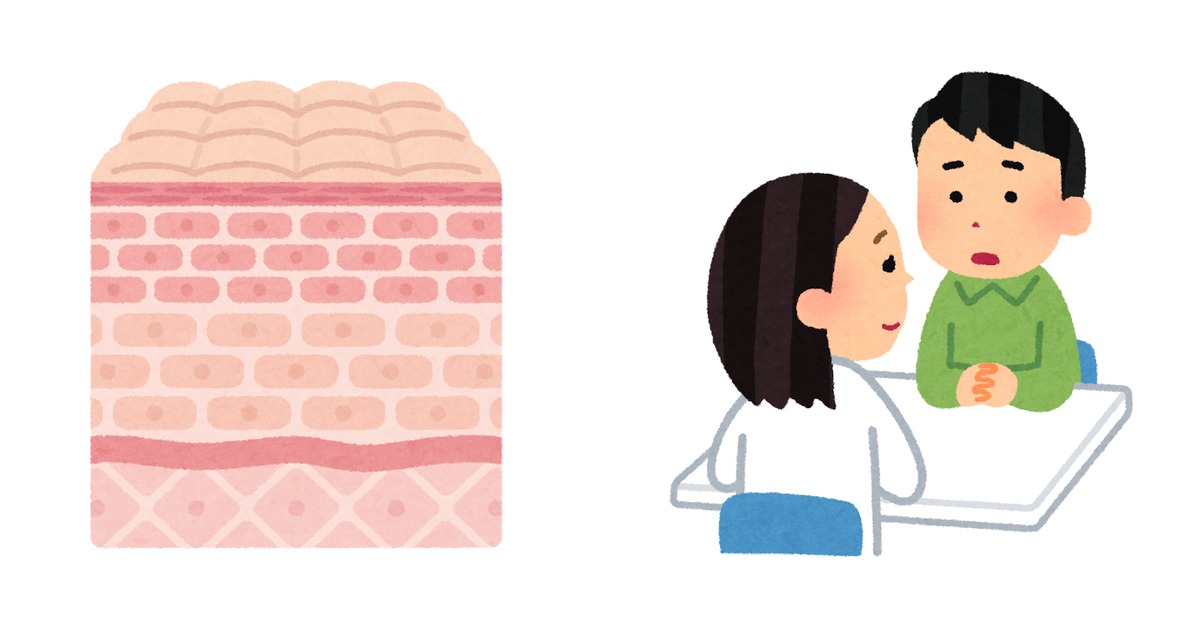
Skin is two layers glued together. The epidermis sits on top, the dermis underneath. A thin sheet called the basement membrane joins them.
The glue is a set of proteins that behave like rivets in a laminated card. Pull the card, and it holds only because the rivets hold.
Laminin 332 is one of those rivets. The National Library of Medicine describes it as a major component of anchoring filaments, which connect the two layers of the basement membrane and help hold the skin together. Laminin 332 is built from three parts: the alpha, beta and gamma subunits. The LAMB3 gene carries the instructions for the beta subunit, and other genes make the alpha and gamma subunits.
LAMB3 sits on chromosome 1, at locus 1q32.2. It spans 23 exons over about 29 kilobases. When both copies carry loss-of-function variants, meaning changes that stop the gene from doing its job, no working beta-3 chain is made. Laminin 332 then cannot be built. In all forms of junctional EB, the skin splits in the lamina lucida, a clear layer inside the basement membrane, or just above it at the hemidesmosomes. Hemidesmosomes are the anchor points under the basal skin cell.
Which gene, and how often
This is not a one-gene disease. GeneReviews gives the split across genes as follows:
| Gene | Share of all junctional EB cases |
|---|---|
| LAMB3 | about 70 percent |
| COL17A1 | about 12 percent |
| LAMA3 | about 9 percent |
| LAMC2 | about 9 percent |
| ITGB4 | under 1 percent |
MedlinePlus agrees that LAMB3 mutations cause about 70 percent of all cases, and that more than 100 LAMB3 mutations have been found.
Seventy percent from one gene. Should I be asking the lab which gene and which change my own report named?
Yes, and that is exactly the right question for a clinician. GeneReviews lists five different genes behind junctional EB, so the gene name matters. Ask a primary care doctor for the full lab report, or bring it to a certified genetic counselor listed at NSGC.org.
A narrower figure covers the severe end. A 2018 study in the Proceedings of the National Academy of Sciences narrowed the frame. It reports that LAMB3 mutations account for 80 percent of patients with Herlitz junctional EB, the generalized severe form. About 95 percent of those LAMB3 mutations are nonsense mutations. A nonsense mutation drops an early stop signal, called a premature termination codon, into the middle of the gene’s message.
Those two percentages measure different denominators and should not be merged. One counts all junctional EB; the other counts only the generalized severe subtype.
The inheritance pattern is stated once and applies throughout. It is autosomal recessive, meaning both copies of the gene must carry mutations for the disease to appear.
A carrier result names a gene, not a diagnosis. A primary care doctor or a certified genetic counselor is the right person to read the actual lab report. A genetic counselor is a health professional trained to explain test results, inheritance and risk numbers.
Section recap: LAMB3 encodes the beta-3 chain of laminin 332, the anchoring-filament protein holding the two skin layers together. Losing both copies removes the protein and separates the layers within the lamina lucida.
What one carrier flag means for your own body, including the dental exception
The part I most need to hear plainly: will this variant ever make me sick?
No, and GeneReviews states it directly: heterozygotes, meaning carriers, have no symptoms. One intact copy makes enough of the beta-3 chain for a normal junction between the skin layers, and there is no age at which that changes.
The first answer is the shortest. A single LAMB3 variant does not cause junctional EB. There is no age at which a carrier becomes a patient. GeneReviews states it plainly: heterozygotes, meaning carriers, have no symptoms. One intact copy makes enough beta-3 chain for a normal junction between the skin layers.
Think of a factory with two production lines making the same part. Shut one down and output still meets demand. Shut both and assembly stops.
The asterisk that carrier pages omit
There is one exception, and it is dental rather than dermatological. In a few rare instances, carriers of a COL17A1, LAMA3 or LAMB3 pathogenic variant have shown dental enamel hypoplasia and pitting, with resulting cavities. Enamel hypoplasia means thin or incompletely formed tooth enamel. That is a dental-care issue, not skin disease, and not a milder version of junctional EB.
The separate dominant story, and the rule behind it
A second finding is more surprising. A 2014 report in the European Journal of Human Genetics found a single-copy LAMB3 frameshift variant, c.3392_3393insG. A frameshift adds or removes letters, so the rest of the gene is read out of step. In these families it caused dominant hypoplastic amelogenesis imperfecta. That is an inherited enamel disorder, and one altered copy is enough to cause it. The variant creates an early stop signal in the final exon of LAMB3.
Position is what makes the difference. Nonsense mutations in the last exon are not thought to trigger nonsense-mediated decay, the cell’s system for destroying faulty messages. The faulty protein is therefore made rather than discarded, and it interferes.
The families in that report had no skin disease at all: no fragility, no blistering, nothing beyond the enamel defect. The authors described it as the first report of dominant amelogenesis imperfecta from a LAMB3 mutation without junctional EB.
The usable rule is about position, not about any individual result. For LAMB3, where a truncating variant sits in the transcript decides what one copy does. The recurrent junctional EB alleles are p.Arg635Ter, p.Gln243Ter, c.957ins77 and p.Arg42Ter, and none of them is a last-exon variant.
No article can say which exon a given reader’s variant sits in. That belongs to the lab report and the clinician who ordered it. The practical step here is small: mention the carrier result to a dentist, and nothing more.
So the only real change in my daily life is telling my dentist?
For the skin, yes. GeneReviews records rare enamel hypoplasia and pitting in a few carriers, so a dentist is worth telling. Anything about the variant itself belongs with the doctor who ordered the test, or with a certified genetic counselor who can read the actual report.
Section recap: One LAMB3 variant leaves the skin normal, and carriers have no symptoms apart from rare enamel hypoplasia and pitting. A separate last-exon mechanism can cause dominant enamel disease with no skin involvement.
The arithmetic: your partner’s status is the whole question
Every page I opened says 25 percent. Is that my number, with my wife untested?
It is not. GeneReviews gives that 25 percent for each pregnancy of two parents who both carry a variant in the same gene. With an untested partner, two separate chances have to be multiplied together instead, and the result lands far lower.
Almost every page prints one number. At conception, each sibling of an affected child whose parents both carry a variant has a 25 percent chance of being affected. There is a 50 percent chance of being a carrier, and a 25 percent chance of neither.
That is 25 out of 100 pregnancies. It applies per pregnancy, not once per family. And it applies only when both parents carry a harmful variant in the same gene.
Step one: the shape of the calculation
For a confirmed LAMB3 carrier with an untested partner, two things multiply. The first is the chance that the partner is also a carrier. The second is the one-in-four transmission risk that follows if they are.
Step two: where the carrier frequency comes from
The published US figures come mainly from one paper. A 2000 study in the Journal of Investigative Dermatology examined LAMB3 in 22 families with Herlitz junctional EB. From that series and from disease incidence, the authors calculated a US carrier risk of one in 781 for Herlitz junctional EB. They calculated one in 350 for all variants of junctional EB. An Italian analysis later gave one in 375 for Herlitz junctional EB.
GeneReviews quotes a third figure, one in 270 for all forms, but attributes it only to a personal communication rather than a published study.
These are back-calculations from a small mutation-screening series and from birth incidence. They are not measurements from large-scale population sequencing. Honest use means presenting a range.
Step three: the multiplication, shown
Each published carrier frequency, with the one-quarter transmission risk applied:
| Chance the partner is a carrier | Where the figure comes from | Multiplied by one quarter |
|---|---|---|
| 1 in 781, Herlitz junctional EB | Nakano 2000, US estimate | about 1 in 3,100 per pregnancy |
| 1 in 350, all junctional EB | Nakano 2000, US estimate | about 1 in 1,400 per pregnancy |
| 1 in 270, all forms | GeneReviews, personal communication | about 1 in 1,100 per pregnancy |
In absolute terms, that is about 0.03 to 0.09 in every 100 pregnancies. The 25 percent figure is two to three orders of magnitude higher, and it is the wrong number here.
One refinement pushes the estimate lower still. The one in 350 and one in 270 figures count carriers of any junctional EB gene, not LAMB3 carriers alone. LAMB3 accounts for about 70 percent of junctional EB cases. What share of carriers hold a LAMB3 variant is not published. The chance for a LAMB3 match is therefore smaller than those two figures suggest. The direction is clear; the exact number is not.
Two things move the number upward, and both belong in a clinic conversation. One is a family history of epidermolysis bullosa on the partner’s side. The other is consanguinity, meaning parents related by blood.
These numbers feel fragile to me. Who checks whether they even apply to us?
A fair worry, and an honest one. The Nakano 2000 carrier frequencies are back-calculated from a small mutation series rather than population sequencing, so a certified genetic counselor should redo the arithmetic with your family history and your partner’s actual result in hand.
The same-gene rule
This rule resolves the most common false alarm in this whole area. Junctional EB requires two pathogenic variants in the same gene.
Think of a door with one lock. Two keys open it only if both are cut for that lock. A key for the neighbour’s door is not half a key for this one.
A partner who carries a COL17A1, LAMA3 or LAMC2 variant therefore creates no risk for LAMB3-related junctional EB. Those genes cause their own forms of the disease, in their own recessive pairs.
One caveat makes a clinician’s input a must. Germline mosaicism and uniparental isodisomy have both been reported here. In germline mosaicism, a parent carries the variant in some egg or sperm cells only. In uniparental isodisomy, a child gets two copies of one chromosome region from a single parent. Either way, a parent’s carrier status needs a gene test to confirm it.
Section recap: The 25 percent figure applies only when both parents carry a variant in the same gene. With an untested partner, the sourced range is roughly one in 1,100 to one in 3,100 per pregnancy.
Consumer chip versus full-gene sequencing: the 48 percent number
It was a mainstream consumer test. Is it not good enough to check my wife with as well?
It is not built for that. The 23andMe package insert states that the test detects three LAMB3 variants, that it is expected to find 48 percent of carriers, and that it does not diagnose any health condition.
The result that brings most readers here came from a genotyping array. An array checks a fixed list of positions. It does not read the gene.
The manufacturer says so in its own regulatory labeling. The 23andMe package insert states that its Carrier Status Test for Severe Junctional Epidermolysis Bullosa (LAMB3-Related) detects 3 variants in the LAMB3 gene. It adds that the test cannot tell whether a person has two copies of a tested variant. The insert’s own numbers, gathered in one place:
| What the insert states | Figure |
|---|---|
| LAMB3 variants tested | 3: R635X, R42X and Q243X |
| Expected share of carriers detected | 48 percent |
| R635X frequency, customers of European ancestry | 0.16 percent |
| R42X frequency | 0.02 percent |
| Q243X frequency | under 0.01 percent |
| Agreement with sequencing | above 99 percent across 157 samples |
| Precision study | correct results for over 99 percent of 204 replicates |
| Diagnoses a health condition | no |
| Meant for prenatal testing | no |
| Covers most LAMB3 variants that cause this disease | no, in any ethnicity |
Those match recurrent alleles that GeneReviews lists among four variants present in roughly 45 percent of US patients with Herlitz junctional EB. The chip looks in a sensible place. It simply looks at very few places.
The number that settles the partner question
One line in the insert decides it. The test is expected to detect 48 percent of carriers for this disease.
Fewer than half. A negative consumer result leaves most carriers undetected, so it cannot clear a partner. The insert is explicit that the test does not include the majority of LAMB3 variants that cause this disease in any ethnicity.
Compare it to a spell-checker that knows only three misspellings. When it flags a word, the flag means something. When it stays silent, the document has not been proofread.
Accuracy is not the limit; coverage is
The test performs well at what it does. As the table shows, agreement with sequencing runs above 99 percent, and a precision study returned correct results for over 99 percent of replicates.
So a positive flag is a real signal, but not a clinical result. The insert states that these tests do not diagnose any health condition, and that the device is not meant for prenatal testing. It also notes that no US professional guidelines now exist for carrier testing for this disease.
What to order instead
The next test is not another chip. It is full sequencing of the partner’s LAMB3 gene, ordered through an obstetric or genetics clinic as part of an expanded carrier screening panel.
The professional framework is worth knowing, along with its gap. A 2021 practice resource from the American College of Medical Genetics and Genomics sorts screening into tiers by carrier frequency. Tier 3 covers conditions of at least moderate severity with a carrier frequency of at least one in 200. The resource recommends that all pregnant patients and those planning a pregnancy be offered Tier 3 screening. Tier 4 covers rarer genes with no lower frequency limit. It is kept for pregnancies where the parents are blood relatives, or where the family history points that way. Neither LAMB3 nor junctional EB is named anywhere in that document.
What follows is a derivation, not an ACMG statement. Every verified US carrier frequency for this disease, from one in 270 to one in 781, is rarer than the one in 200 Tier 3 threshold. LAMB3 therefore falls into Tier 4 territory by frequency alone.
That creates a practical trap. A standard panel may or may not include LAMB3, so the gene has to be asked about by name rather than assumed. The framework also describes which panel a clinic offers routinely. It says nothing against testing a known carrier’s partner, where the relevant test is full sequencing of that same gene.
Then what exactly should I ask for, and who is the person who orders it?
Full sequencing of the partner’s LAMB3, asked for by name rather than assumed. The 2021 ACMG practice resource describes which panels a clinic offers routinely, so an obstetric provider or a certified genetic counselor is the right person to place that order.
Which panel, and how it is ordered, is a conversation for an obstetric provider or a certified genetic counselor.
Section recap: The consumer test checks three LAMB3 variants and detects an expected 48 percent of carriers, so a negative result cannot clear a partner. The partner needs full-gene LAMB3 sequencing ordered through a clinic.
What generalized severe JEB looks like, and the subtypes it gets confused with
I saw photographs of newborns before I saw a single fact. I have not slept properly since.
That is how most people meet this disease, and it is a hard first encounter. MedlinePlus describes the generalized severe form as extensive blistering from birth, and states plainly that this form is typically fatal within the first year of life.
Search results deliver the frightening version first. Structure is more useful than dread, so here is what the sources record.
MedlinePlus describes generalized severe junctional EB, formerly Herlitz JEB, as extensive blistering from birth or early infancy. It notes granulation tissue, meaning raw healing tissue that builds up in wounds, and airway involvement. It states that this form is typically fatal within the first year of life. Research groups working on the disease describe it in the same terms, as severe and often lethal.
The numbers, with their real sources
Two figures circulate together and come from different places. Attribution matters.
For prevalence, GeneReviews cites the National EB Registry: the prevalence of all types of junctional EB is 0.44 per million in the US population. For mortality, the widely quoted 73 percent does not come from that registry. GeneReviews attributes it to a single case series, in which 73 percent of 71 children born over a five-year period died at an average age of five months. Seventy-one children is a small series, and it should be read as one.
MedlinePlus states that both types together affect about 3 per million people per year in the United States.
The look-alikes
Junctional EB is not one clinical picture, and it is often mixed up with its neighbours. The three that matter here, side by side:
| Form | Gene | How it differs |
|---|---|---|
| Generalized severe junctional EB, once called Herlitz | LAMB3 in about 80 percent of patients | wide blistering from birth, granulation tissue, airway involvement, typically fatal in the first year |
| Generalized intermediate junctional EB, once called non-Herlitz | can come from LAMB3 as well | blistering often limited to hands, feet, knees and elbows, may improve after infancy, normal lifespan is typical |
| Dystrophic EB | COL7A1 | a separate disease of a different anchor protein, and the target of the two gene therapies in the next section |
MedlinePlus describes that second type, the generalized intermediate form, in those terms. It can come from this same gene: a clinical trial registered with the National Library of Medicine was designed for patients with generalized intermediate LAMB3-dependent junctional EB.
So LAMB3 does not mean one outcome. It spans a range, and which end depends on what the two variants do to the protein. Dystrophic epidermolysis bullosa, or dystrophic EB, is a separate disease caused by mutations in the collagen type VII alpha 1 chain gene, COL7A1. That difference becomes decisive in the next section.
So the same gene can lead to very different outcomes?
It can. MedlinePlus describes a generalized intermediate form that is compatible with a normal lifespan, and a trial registered on ClinicalTrials.gov was designed for LAMB3-dependent intermediate disease. Which end applies to any one family is a question for a clinical geneticist.
How diagnosis is made now
The method has changed. A skin biopsy read by electron microscope, or stained with antibodies to show which protein is missing, can still be done. Neither is the preferred method now. Diagnosis is made by gene testing that finds a harmful variant in both copies of the gene. For ongoing care, the GeneReviews management summary lists a yearly check for iron-deficiency anemia, low zinc and low vitamin D. All of that belongs with a treating doctor rather than a search engine.
Section recap: The generalized severe form is typically fatal within the first year, and the 73 percent figure comes from a 71-child series rather than the National EB Registry. LAMB3 can also cause the generalized intermediate form, which is compatible with a normal lifespan.
Treatment in 2026: dated approvals, and two drugs that are not for this disease
A friend sent me a headline about a gene therapy cure for EB. Does any of that apply to us?
Not to this disease, and the labels settle it. The FDA labeling for VYJUVEK and for ZEVASKYN names dystrophic EB caused by COL7A1 variants, and neither indication mentions junctional EB. They address a different gene and a different protein.
Every claim here carries a regulator, a date and an indication. The most valuable correction available is a negative one.
VYJUVEK and ZEVASKYN are not for junctional EB
Two gene therapies for epidermolysis bullosa reached the US market recently. News coverage has left many readers assuming a cure now exists for this disease. Reading the approved indication lines side by side settles it.
The three products in play, with their labels read side by side:
| Product | Regulator and date | Approved indication | Names junctional EB? |
|---|---|---|---|
| VYJUVEK | FDA, approval letter 19 May 2023; label states initial US approval 2023 | wounds in adults and children with dystrophic EB carrying COL7A1 mutations | No |
| ZEVASKYN | FDA, approval letter 28 April 2025; label states initial US approval 2025 | wounds in adults and children with recessive dystrophic EB | No |
| FILSUVEZ | FDA, 18 December 2023, under NDA 215064; no Health Canada authorization as of 29 August 2026 | wounds from dystrophic and junctional EB, in patients 6 months and older | Yes |
Neither gene therapy label mentions junctional EB, and neither mentions LAMB3. They are addressed to a different disease, the way two houses on one street receive different mail.
What does apply, and where
One approved product names this disease. The Drugs@FDA entry for FILSUVEZ lists application number NDA 215064, sponsor Chiesi, and original approval on 18 December 2023. It went through priority review and holds orphan status, the tag given to drugs for rare diseases. The product is a topical botanical drug: a refined birch bark extract, quantified to 72 to 88 percent betulin.
Canada is different, and the difference is verifiable. A live query of the Health Canada Drug Product Database on 29 August 2026 returned no record for FILSUVEZ or Oleogel. A full download of the Notice of Compliance dataset contained no match either. As of that date the product holds no Canadian market authorization.
The sponsor reports a pending step. In an announcement dated 9 June 2026, Chiesi stated that Health Canada accepted its New Drug Submission for priority review. The target is roughly 180 days rather than the traditional 300. The same announcement confirms that the product has not received market authorization in Canada. That is a company source, and it is dated as one.
One general note, offered as background rather than as a sourced claim: Health Canada runs a Special Access Program, through which clinicians may request drugs not sold in Canada. Nothing here says that FILSUVEZ has been supplied that way. Whether that route fits any individual is a question for a treating doctor.
How strong is the wound-care evidence
Approval is not the same as effect size. The phase III EASE study is the main evidence, and it should be read with its limits attached.
EASE ran a 90-day double-blind phase, in which nobody knew who got the gel. It then ran a 24-month open-label phase, in which everyone did know. That second phase took in 205 patients as one group, with nothing to compare them against. The composition matters here. Some 178 patients, or 86.8 percent, had dystrophic EB, while 25 patients, or 12.2 percent, had junctional EB. That is roughly one in eight.
The reported changes are modest. Body surface area percentage, the share of skin covered by wounds, changed from baseline by minus 3.7 percent at 24 months. The P value was 0.003, so the change is unlikely to be chance alone. Skin activity on the EBDASI scale, a scoring system for EB skin damage, changed by minus 3.0, with a P value of 0.007. Adverse events were reported in 77.1 percent of patients, severe events in 18.0 percent, and serious events in 24.4 percent. Nine deaths were reported, none attributed to the treatment.
The evidence is also contested in print, which is worth knowing rather than hiding. A 2026 correspondence in the British Journal of Dermatology raised three methodological concerns. Wound-related events counted as adverse events, reported in 41.0 percent of patients, also fed into the efficacy endpoints. The correspondents argued that this risks misclassification bias, meaning events sorted into the wrong bucket. Only 59 of 109 patients in the treatment group, or 54.1 percent, completed the 24-month body surface area percentage assessment. They asked for extra checks on how much the missing data could have moved the result. The study authors published a formal reply in the same issue.
The research line that is actually about LAMB3
One body of work targets this gene directly. One 2017 result in Nature stands out. Autologous transgenic keratinocyte cultures regenerated an entire, fully working epidermis on a seven-year-old child with a life-threatening form of junctional EB. Those cultures were sheets of the child’s own skin cells, grown in the lab after a working copy of the gene had been added. Clonal tracing showed that human epidermis is kept going by a small number of long-lived stem cells, detected as holoclones.
A five-year follow-up on the same patient appeared in the New England Journal of Medicine in 2021. That report opens by stating there is no established cure for inherited junctional EB. It is a single-patient durability report, not a controlled trial.
The next step did not go as planned, and readers deserve the actual status. A multi-site pivotal trial of the same gene-corrected skin grafts, registered as NCT05111600, has an overall status of terminated. Its actual enrollment was 2 participants, and its primary completion date was 12 March 2024. The registry gives the reason as a development program review and update, due to a sponsor re-organization.
That is not a failure of the science reported in 2017. It is a stalled development program, and no approved LAMB3 gene therapy exists anywhere as a result.
Reading through a premature stop
Most LAMB3 alleles in generalized severe junctional EB are premature termination codons, so forcing the cell to read past the stop is a rational strategy for this gene. The 2018 PNAS work showed it can be done in the lab. Gentamicin induced readthrough of all eight LAMB3 nonsense mutations tested. The restored laminin 332 was assembled, secreted and correctly deposited at the junction in a three-dimensional skin model.
The clinical evidence is small, and honest about it. A 2022 open-label pilot trial in JAMA Dermatology enrolled five pediatric patients with junctional EB and confirmed nonsense variants in LAMA3 or LAMB3. Three received intravenous gentamicin at 7.5 mg/kg daily for 14 days, and two received 10 mg/kg daily for 24 days. All five showed increased laminin 332 at the dermal-epidermal junction. By three months, 8 of 9 wounds in the low-dose group and all wounds in the high-dose group had closed by more than 85 percent. No harm to hearing, no harm to the kidneys and no anti-laminin 332 antibodies were detected.
Five children, no control arm, one institution. The authors wrote that long-term safety and benefit need further study. No regulator has approved gentamicin for this use, and the approach is still experimental.
The honest 2026 summary is short. No approved therapy anywhere changes the natural history of this disease. What exists is wound care approved in the US, a research pathway that has stalled, and a readthrough strategy that is still experimental. Weighing any of it against a real clinical situation needs a doctor at an EB centre.
Is there anything real to hold on to right now?
There is serious research, but nothing approved anywhere that changes the course of this disease. The 2017 Nature report and the 2022 JAMA Dermatology gentamicin pilot are early work with very few patients. A doctor at a recognised EB centre can say what applies today.
Section recap: VYJUVEK and ZEVASKYN are COL7A1 dystrophic EB products, and neither indication names junctional EB. FILSUVEZ was FDA-approved on 18 December 2023 under NDA 215064, and holds no Health Canada authorization as of 29 August 2026.
Telling your family and planning a pregnancy
Do I really have to call my sister about this? We are not close.
That call is hard, and it is also genuinely useful. For a recessive condition the variant came from a parent, and GeneReviews notes that once the exact familial variant is known, relatives can be tested for that single change rather than screened broadly.
A carrier result is never about one person. The variant arrived from a parent, so it may sit in siblings, and it will sit in half of any children.
The cascade arithmetic
For an autosomal recessive condition, one variant copy came from one parent. That parent carries the same variant. Each full sibling therefore inherited it with a chance of about one in two, or 50 out of 100. Each child of a carrier also has about a 50 percent chance of inheriting the single copy. Inheriting one copy makes a carrier, not a patient.
That is why the phone call to a sibling is practical rather than merely awkward. Once the exact familial variant is known, relatives can be tested for that one variant. It is a far smaller test than sequencing a whole panel.
One caution applies to the whole family tree. As in the risk section above, a parent’s carrier status has to be shown by a gene test, not worked out by inference.
The reproductive options, stated neutrally
Once the harmful variants have been identified in an affected family member, prenatal testing and preimplantation genetic testing become possible. Preimplantation genetic testing means testing embryos made through in vitro fertilization, before one is transferred. Fetoscopy, an older and higher-risk approach performed at 18 to 20 weeks, is not currently available in the US.
Both routes share one prerequisite. They require knowing both parents’ exact variants first. That is the practical reason partner sequencing comes before any decision about how to conceive.
The full set of options belongs on the table, in no ranked order:
- conceiving naturally and accepting the calculated risk
- prenatal diagnosis, once both parents’ variants are known
- preimplantation genetic testing with in vitro fertilization
- donor eggs or sperm
- adoption
- choosing not to pursue pregnancy
Costs and coverage vary by country, plan, province and state, so only a local clinic can give real figures.
And if my wife does turn out to be a carrier, what are the real options?
Several, and none of them is ranked here. GeneReviews notes that prenatal testing and preimplantation genetic testing become possible once both parents’ variants are identified. A certified genetic counselor, findable through the NSGC directory, is the right person to talk them through.
Who to call, and when
There is a specific directory for this. The National Society of Genetic Counselors runs a Find a Genetic Counselor directory with access to over 3,300 genetic counselors across the US and Canada. It can be searched for in-person or telehealth visits. The society notes that it is a member list, not a referral service. In Canada, the Canadian Association of Genetic Counsellors runs a Find a Clinic tool at genetic-counsellors.ca. It lists genetics staff and clinics by location or area of practice.
The sequence that follows from everything above is short. Confirm the variant through a clinical lab on a clinician’s order. Get the partner’s LAMB3 gene fully sequenced. Then book a certified genetic counselor before making any reproductive decision.
Section recap: Each full sibling has roughly a 50 percent chance of carrying the same variant, and testing for a known familial variant is targeted and small. Prenatal and preimplantation testing become possible only once both parents’ variants are identified.
Insurance, employment law and the emotional load
Can an insurer or my employer use this result against me?
In the main areas, no, though the limits matter. The National Human Genome Research Institute states that GINA bars health insurers from using genetic information, and bars employers with fifteen or more staff from using it in hiring, pay or promotion decisions.
Vagueness costs money here, so this section stays at statute level.
United States
The Genetic Information Nondiscrimination Act of 2008 has two relevant titles. Title I bars insurers from using genetic information in eligibility, coverage, underwriting or premium decisions. Underwriting is the step where an insurer decides whether to cover a person, and at what price. Title I applies to private health insurers, Medicare, Medicaid, Federal Employees Health Benefits and the Veterans Health Administration.
Title II covers employment. It prevents employers from using genetic information in hiring, firing, promotions, pay and job assignments. The National Human Genome Research Institute states the threshold explicitly: GINA does not apply to employers with fewer than 15 employees.
Now the gap, in the agency’s own words. GINA’s health insurance protections do not cover long-term care insurance, life insurance, or disability insurance. Some states add their own protections, and the military is permitted to use genetic information for employment decisions.
Picture an umbrella that covers three products and leaves three others in the rain. A carrier result cannot lawfully be used by a US health insurer, or by an employer of 15 or more. Underwriting questions on a term life, disability or long-term care application are a different matter, and they are lawful.
Canada
Canada’s protection is broader, and the difference is real. Section 3 of the Genetic Non-Discrimination Act bans requiring a genetic test as a condition of providing goods or services. The same ban covers entering into or continuing a contract.
The penalties are substantial. On indictment, a fine of up to one million dollars and imprisonment for up to five years. On summary conviction, up to three hundred thousand dollars and twelve months.
The statute survived a constitutional challenge. In Reference re Genetic Non-Discrimination Act, 2020 SCC 17, decided 10 July 2020, a 5-4 majority of the Supreme Court of Canada upheld it. Parliament had the power to criminalise forcing someone to take a genetic test or reveal its results.
The contrast is the cleanest cross-border fact in this article. The Canadian ban covers any goods, services, contract or agreement. It has no carve-out matching GINA’s exclusion of life, disability and long-term care insurance.
| Where a carrier result could be used | United States, under GINA | Canada, under the Genetic Non-Discrimination Act |
|---|---|---|
| Health insurance | Barred, across private plans, Medicare, Medicaid, federal employee plans and the Veterans Health Administration | Barred: no test or its results may be required for any service or contract |
| Life insurance | Not covered by GINA | No carve-out; the ban covers any contract |
| Disability insurance | Not covered by GINA | No carve-out; the ban covers any contract |
| Long-term care insurance | Not covered by GINA | No carve-out; the ban covers any contract |
| Employment | Barred, except at employers with fewer than 15 staff; the military may use genetic information | The ban covers any contract or agreement |
| Penalty named in the cited source | Not stated on the NHGRI page cited here | Up to one million dollars and five years in prison, on indictment |
The part that is not legal
Carrier guilt is common and misplaced. Carrier status is not a diagnosis, it was not a choice, and it should never be recorded as a disease in a medical file.
And the guilt? I keep feeling as though I did something to my kids.
Carrier status was never a choice, and it is not a diagnosis. That feeling comes up constantly, and a certified genetic counselor is trained for exactly that conversation. GeneReviews also lists debra of America among the support groups for this disease.
Disclosure to siblings and partners has timing, and there is no universal right answer. A certified genetic counselor is trained for exactly that conversation, which is one more reason to make the appointment. Support also exists outside the clinic. GeneReviews lists DEBRA International and debra of America, reachable at 833-332-7287, among the support groups for this disease.
Section recap: GINA blocks US health insurers and employers of 15 or more, but explicitly not life, disability or long-term care insurance. Canada’s Genetic Non-Discrimination Act, upheld in 2020 SCC 17, covers any contract or service, life insurance included.
Frequently asked questions
Will I get the disease?
No. Junctional EB is autosomal recessive, so both copies of the gene must carry mutations. Carriers are described as having no symptoms. The one recorded exception is rare dental enamel hypoplasia, meaning thin enamel, with pitting. There is no age at which a carrier converts into a patient. Mentioning the result to a dentist is reasonable, and nothing else about personal health changes.
Will my children inherit it?
Each child has about a 50 percent chance of inheriting the single variant and becoming a carrier, which causes no disease. For a child to be affected, the other parent must also carry a harmful variant in LAMB3 specifically. If both parents carry one, each pregnancy carries a 25 percent chance of an affected child. With an untested partner and no family history, the sourced estimate is roughly one in 1,100 to one in 3,100 per pregnancy. A genetic counselor can redo this math once the partner is sequenced.
Will this affect my health or life insurance?
In the US, health insurance is protected and life insurance is not. GINA bars insurers from using genetic information in eligibility, underwriting or premium decisions. That cover runs across private plans, Medicare, Medicaid, federal employee plans and the Veterans Health Administration. The same agency states that it does not reach long-term care, life or disability insurance. In Canada, the federal statute bars requiring a test or its results as a condition of any contract or service, with no life-insurance carve-out. Anyone about to apply for term life should raise this with a counselor first.
Can my employer find out?
Not lawfully, in most US workplaces. GINA Title II stops employers from using genetic information in hiring, firing, promotions, pay and job assignments. The one stated exception is size. The law does not apply to employers with fewer than 15 staff. The military is also allowed to use genetic information for employment decisions. In Canada, requiring a test or its results as a condition of a contract is an offence, backed by fines up to one million dollars.
Should I get a second opinion?
The consumer result should be confirmed before it is used for any reproductive decision. The maker’s own labeling states that these tests do not diagnose any health condition, and are not meant for prenatal testing. A clinical diagnostic lab also pins down the exact variant. Relatives, and any future testing of embryos, will need that exact variant. A certified genetic counselor is the right professional for that step, and the NSGC and CAGC directories list them by location and by telehealth.
Section recap: The common questions have short answers, and most of them route to a partner’s sequencing result and a certified genetic counselor rather than to another consumer kit.
Summary
A LAMB3 carrier flag describes a future pregnancy, not a present body. The disease is autosomal recessive, and carriers have no symptoms apart from rare dental enamel findings. A separate last-exon mechanism can cause dominant enamel disease with no skin involvement at all.
The arithmetic is the part worth carrying away. Twenty-five out of 100 applies only when both parents carry a variant in the same gene. Now take an untested partner. Published carrier frequencies of one in 781, one in 350 and one in 270 give three per-pregnancy numbers. They are roughly one in 3,100, one in 1,400 and one in 1,100. That is about 0.03 to 0.09 in every 100. All are rough estimates back-calculated from small series, not population measurements.
The same-gene rule resolves the most common false alarm. A partner carrying COL17A1, LAMA3 or LAMC2 poses no risk for LAMB3-related junctional EB.
The one action that changes the number is partner sequencing. The consumer test checks three LAMB3 variants and detects an expected 48 percent of carriers, so a second kit cannot clear anyone. Full-gene sequencing through a clinic can.
On treatment, the dated facts are these. VYJUVEK and ZEVASKYN are indicated for dystrophic EB with COL7A1 variants, and neither names junctional EB. FILSUVEZ was approved by the FDA on 18 December 2023 under NDA 215064, for dystrophic and junctional EB wounds in patients 6 months and older. It is in neither Health Canada database as of 29 August 2026, though the sponsor reports a priority review accepted in June 2026. The EASE 24-month evidence covers only 25 junctional EB patients out of 205, and is contested in print. The LAMB3-specific gene therapy work published in 2017 and 2021 is real, and its pivotal trial was terminated in 2024 after enrolling two participants.
This article is a research aggregation, not a clinical consultation. The remaining questions can only be answered by a certified genetic counselor and a clinical lab. Those include which variant this is, what a partner’s sequencing shows, and what it means for a specific pregnancy.
This article is for educational purposes only. It is not a substitute for advice from a licensed physician, board-certified medical geneticist, or board-certified genetic counselor. For any decisions about testing, treatment, or care, consult a qualified clinician. In emergencies, call 911.
References
- Pfendner EG, Lucky AW. Junctional Epidermolysis Bullosa. GeneReviews, University of Washington, Seattle / NCBI Bookshelf (NIH National Library of Medicine). Initial posting 22 February 2008; last update 20 December 2018; revision date confirmed on the live page 29 August 2026. https://www.ncbi.nlm.nih.gov/books/NBK1125/
- MedlinePlus Genetics, National Library of Medicine (NIH). “Junctional epidermolysis bullosa” (condition page, last updated 1 April 2020) and “LAMB3 gene” (gene page, last updated 1 July 2019). Both retrieved live 29 August 2026. https://medlineplus.gov/genetics/condition/junctional-epidermolysis-bullosa/
- Hirsch T, Rothoeft T, Teig N, et al. (2017). Regeneration of the entire human epidermis using transgenic stem cells. Nature 551(7680):327-332. DOI 10.1038/nature24487. PMID 29144448. PMCID PMC6283270. https://pubmed.ncbi.nlm.nih.gov/29144448/
- Kueckelhaus M, Rothoeft T, De Rosa L, et al. (2021). Transgenic Epidermal Cultures for Junctional Epidermolysis Bullosa – 5-Year Outcomes. New England Journal of Medicine 385(24):2264-2270 (9 December 2021). DOI 10.1056/NEJMoa2108544. PMID 34881838. https://pubmed.ncbi.nlm.nih.gov/34881838/
- ClinicalTrials.gov (NIH National Library of Medicine), registry record NCT05111600, sponsor Holostem s.r.l. Pivotal trial of autologous fibrin-cultured epidermal grafts genetically modified with a LAMB3 retroviral vector (Hologene 5), in generalized intermediate LAMB3-dependent junctional epidermolysis bullosa. Overall status TERMINATED; actual enrollment 2; primary completion 12 March 2024. Retrieved via API v2 on 29 August 2026. https://clinicaltrials.gov/study/NCT05111600
- Lincoln V, Cogan J, Hou Y, et al. (2018). Gentamicin induces LAMB3 nonsense mutation readthrough and restores functional laminin 332 in junctional epidermolysis bullosa. Proceedings of the National Academy of Sciences 115(28):E6536-E6545. DOI 10.1073/pnas.1803154115. PMID 29946029. PMCID PMC6048497. https://pubmed.ncbi.nlm.nih.gov/29946029/
- Mosallaei D, Hao M, Antaya RJ, et al. (2022). Molecular and Clinical Outcomes After Intravenous Gentamicin Treatment for Patients With Junctional Epidermolysis Bullosa Caused by Nonsense Variants. JAMA Dermatology 158(4):366-374. DOI 10.1001/jamadermatol.2021.5992. PMID 35234826. PMCID PMC8892363. https://pubmed.ncbi.nlm.nih.gov/35234826/
- Murrell DF, Bodemer C, Bruckner AL, et al., on behalf of the EASE investigators (2025). Long-term safety and efficacy of Oleogel-S10 (birch bark extract) in epidermolysis bullosa: 24-month results from the phase III EASE study. British Journal of Dermatology 192(6):1007-1017. DOI 10.1093/bjd/ljaf022. PMID 39821055. https://pubmed.ncbi.nlm.nih.gov/39821055/
- Cao Q, Yang L, He X (2026). Methodological concerns in the EASE study of Oleogel-S10 for epidermolysis bullosa. British Journal of Dermatology 194(1):175. DOI 10.1093/bjd/ljaf355. PMID 40913439. With the authors’ reply: Murrell DF, Bodemer C, Bruckner AL, et al. (2026). British Journal of Dermatology 194(1):175-177. DOI 10.1093/bjd/ljaf365. PMID 40971525. https://pubmed.ncbi.nlm.nih.gov/40913439/
- US Food and Drug Administration, Drugs@FDA application records and current prescribing information, retrieved via the openFDA drug/drugsfda and drug/label APIs and DailyMed (NLM) on 29 August 2026. FILSUVEZ NDA 215064, original approval 18 December 2023, sponsor Chiesi, priority review, orphan designation. VYJUVEK, initial US approval 2023, approval letter 19 May 2023, Krystal Biotech, indicated for dystrophic EB with COL7A1 mutations. ZEVASKYN, initial US approval 2025, approval letter 28 April 2025, Abeona Therapeutics, indicated for recessive dystrophic EB. https://www.accessdata.fda.gov/drugsatfda_docs/label/2023/215064s000lbl.pdf
- Health Canada, Drug Product Database and Notice of Compliance database, queried live 29 August 2026 via the health-products.canada.ca open APIs. No product record for FILSUVEZ or Oleogel under any status, and no Notice of Compliance match in the full dataset. https://health-products.canada.ca/dpd-bdpp/index-eng.jsp
- Chiesi Global Rare Diseases (9 June 2026). Chiesi Global Rare Diseases Announces Health Canada Grants Priority Review for FILSUVEZ (birch triterpenes) Topical Gel for the Treatment of Epidermolysis Bullosa. Company press release via GlobeNewswire, cited only for the sponsor’s statements about its own submission. https://www.globenewswire.com/news-release/2026/06/09/3308760/0/en/chiesi-global-rare-diseases-announces-health-canada-grants-priority-review-for-filsuvez-birch-triterpenes-topical-gel-for-the-treatment-of-epidermolysis-bullosa.html
- Nakano A, Pfendner E, Hashimoto I, Uitto J (2000). Herlitz junctional epidermolysis bullosa: novel and recurrent mutations in the LAMB3 gene and the population carrier frequency. Journal of Investigative Dermatology 115(3):493-498. DOI 10.1046/j.1523-1747.2000.00086.x. PMID 11023379. With Castori M, et al. (2008). British Journal of Dermatology 158(1):38-44. DOI 10.1111/j.1365-2133.2007.08208.x. PMID 17916201. https://pubmed.ncbi.nlm.nih.gov/11023379/
- Poulter JA, El-Sayed W, Shore RC, Kirkham J, Inglehearn CF, Mighell AJ (2014). Whole-exome sequencing, without prior linkage, identifies a mutation in LAMB3 as a cause of dominant hypoplastic amelogenesis imperfecta. European Journal of Human Genetics 22(1):132-135. DOI 10.1038/ejhg.2013.76. PMID 23632796. PMCID PMC3865405. With Lee KE, et al. (2015). Clinical Genetics 87(1):90-92. DOI 10.1111/cge.12340. PMID 24494736. https://pubmed.ncbi.nlm.nih.gov/23632796/
- Gregg AR, Aarabi M, Klugman S, et al.; ACMG Professional Practice and Guidelines Committee (2021). Screening for autosomal recessive and X-linked conditions during pregnancy and preconception: a practice resource of the American College of Medical Genetics and Genomics. Genetics in Medicine 23(10):1793-1806. DOI 10.1038/s41436-021-01203-z. PMID 34285390. PMCID PMC8488021. https://pubmed.ncbi.nlm.nih.gov/34285390/
- National Human Genome Research Institute (NIH). Genetic Discrimination and the Genetic Information Nondiscrimination Act of 2008. Page last updated 6 January 2022; read live 29 August 2026. https://www.genome.gov/about-genomics/policy-issues/Genetic-Discrimination
- Genetic Non-Discrimination Act, S.C. 2017, c. 3, Justice Laws Website, Department of Justice Canada; and Reference re Genetic Non-Discrimination Act, 2020 SCC 17 (judgment 10 July 2020), Supreme Court of Canada. Both retrieved live 29 August 2026. https://laws-lois.justice.gc.ca/eng/acts/G-2.5/
- 23andMe, Inc. Personal Genome Service (PGS) Package Insert v5, FDA-required device labeling. Carrier Status Test for Severe Junctional Epidermolysis Bullosa (LAMB3-Related): Indications for Use, special considerations, carrier detection rate and analytical performance. Retrieved live 29 August 2026, and cited as company-authored regulatory labeling. https://permalinks.23andme.com/pdf/package_insert_v5.pdf
- National Society of Genetic Counselors, Find a Genetic Counselor directory; and Canadian Association of Genetic Counsellors, Find a Clinic. Both retrieved live 29 August 2026. https://findageneticcounselor.nsgc.org/
Last updated: 2026-08-29
Author: Yu Mizuno (Editor-in-Chief, non-physician), GeneLumen editorial team. This article aggregates 19 sources from peer-reviewed medical literature and public health agencies (tier 1=12 / tier 2=4 / tier 3=3), including NIH resources (MedlinePlus Genetics, GeneReviews, NHGRI, ClinicalTrials.gov), the FDA and DailyMed, the Health Canada Drug Product Database and Notice of Compliance database, ACMG practice resources, Canadian federal statute and Supreme Court sources, and PubMed-indexed publications. Editorial lead: Yu Mizuno, a non-physician research editor.
This article is for educational purposes only and is not a substitute for medical advice from a licensed physician, board-certified medical geneticist, or board-certified genetic counselor. In emergencies, call 911 (US/Canada).
Related: Genetic Diseases category